49 to 50: why not one Democrat voted to start debate on the CLARITY Act
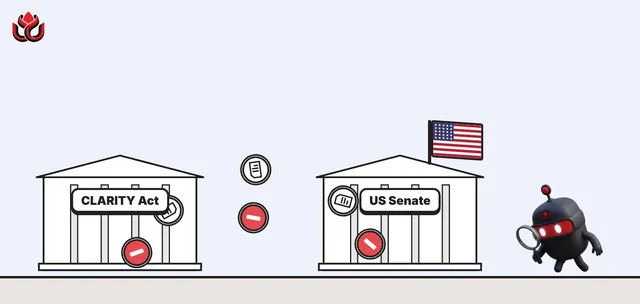
The Senate fell 11 votes short of the 60 needed to take up America's crypto market structure bill on September 15. Democrats who backed it in committee said the ethics rules for the president were too thin.
Key points
- The Senate voted 49 to 50 on September 15, 2026, to start debate on the CLARITY Act. It needed 60.
- Every yes vote came from a Republican, and four Republicans voted no. Even with them, the bill would have been seven votes short.
- Democrats, including Senator Alsobrooks, who backed the bill in committee, said they would not support it without ethics rules covering the president.
The vote
The biggest crypto bill in Washington hit a wall on September 15, 2026. The Senate voted 49 to 50 on a procedural motion to begin debate on the Digital Asset Market Clarity Act, known as the CLARITY Act (H.R. 3633), according to the Senate roll call record. A cloture vote is the step that ends a filibuster. It needs three-fifths of the Senate, or 60 votes, so the bill fell 11 short.
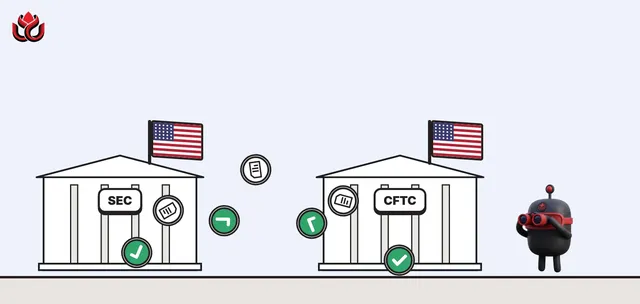
The CLARITY Act is a market structure bill. In plain terms, it is meant to set out which crypto assets and platforms fall under the Securities and Exchange Commission (SEC), which fall under the Commodity Futures Trading Commission (CFTC), and what rules firms must follow. The Senate Banking Committee advanced it 15 to 9 on May 14, 2026, with Chairman Tim Scott saying it brings "digital assets into the sunlight".
Who voted how
Every one of the 49 votes to proceed came from Republicans. No Democrat voted yes. Four Republicans voted no: Susan Collins of Maine, Josh Hawley of Missouri, Jerry Moran of Kansas and Thom Tillis of North Carolina. Democrat Chris Coons of Delaware did not vote, the roll call shows.
The math shows how far apart the sides were. Even if all four Republican holdouts had switched, the yes side would have reached 53, still seven short of 60. Any path to passage needs Democratic votes.
CLARITY Act cloture vote, September 15, 2026
votes
Source: US Senate, Roll Call Vote 234, 119th Congress, 2nd Session

Why Democrats said no
Ethics was the common thread. Senator Elissa Slotkin of Michigan said the bill's ethics rules were too weak given crypto profits tied to the president, his children and Cabinet members, and that she would not back a law that allows such conduct. Her short verdict: "The ethics provisions in this bill are simply too thin."
Senator Angela Alsobrooks of Maryland voted for the bill in committee in May. On the floor she voted no. She said she would not back "a bill that doesn't include clear ethics provisions" covering the president and future officeholders, and said Republican leaders halted talks on a deal at the last minute.
What the bill would have done
Without a market structure law, US crypto firms work under a patchwork. Some tokens may be treated as securities under the SEC, some as commodities under the CFTC, and many exchanges rely on state licenses that were built for payments, not trading. The CLARITY Act was meant to draw those lines in federal law.
The bill had cleared the Senate Banking Committee with support from both parties in May. Slotkin, for one, said her objections went beyond ethics: she wanted stronger tools to cut off funding to terrorists and to countries such as North Korea and Iran, and said the CFTC lacks the oversight capacity and staffing to run a new crypto regime. She also said parts of the bill had bipartisan support and that she is willing to keep working on them.

What Republicans said
Chairman Scott said nearly all Senate Republicans voted to move forward and blamed Senate Democrats for the failure. He framed the vote as progress and called on the SEC and CFTC to write clear rules for digital assets until Congress acts, his statement said.
Regulators step in
The agencies moved quickly. Two days after the vote, on September 17, 2026, the SEC issued a temporary "Innovation Exemption" that lets approved on-chain venues trade tokenized US stocks. Chairman Paul Atkins named the failure of the CLARITY Act as part of the context and said the interim step must be followed by lasting rules, his statement said.
The SEC called its exemption a temporary first step and invited public comment. On October 5, CFTC Chairman Michael Selig proposed the agency's first crypto market rules, which would let CFTC-registered exchanges offer retail clients margined and leveraged crypto trading. He pointed to the Senate's failure to advance the bill and noted that his agency cannot force crypto trading onto CFTC platforms without Congress, the CFTC said.
Agency rules can fill some gaps, not all. A law binds future regulators. Agency rules can be rewritten by the next set of commissioners.
Timeline
Senate Banking Committee advances H.R. 3633 by 15 to 9
Cloture on the motion to proceed fails 49 to 50
SEC issues a temporary Innovation Exemption, citing the stalled bill
CFTC chairman cites the failed vote as he proposes crypto market rules
LC Insight analysis
This section is our reading of the facts above, not a statement of fact.
- The fight is no longer about the SEC versus the CFTC. It is about ethics. Democrats who backed the text in May drew a line on rules for the president and senior officials, and that is a political problem, not a technical one.
- We expect agencies, not Congress, to write most US crypto rules for the next year. Firms get guidance, but not the lasting certainty a law would bring.
- A deal on ethics language could revive the bill, but the numbers are hard. Even with every Republican on board, at least seven Democrats would have to switch.
What's next
- Whether Senate leaders bring the bill back in the lame-duck session after the November elections
- Any bipartisan ethics text covering the president and senior officials
- SEC and CFTC rulemakings that try to fill the gap
Disclaimer. This article is based on public information and the sources listed below as of the update time shown. It is for information only and is not investment, legal or tax advice. Figures may change as companies and authorities publish new data.
Sources
- US Senate, Roll Call Vote 234 on cloture on the motion to proceed to H.R. 3633 (September 15, 2026)
- Senate Banking Committee, Scott statement on Clarity Act vote (September 15, 2026)
- Senate Banking Committee, Committee advances Clarity Act (May 14, 2026)
- Senator Elissa Slotkin, Statement on voting no (September 15, 2026)
- Senator Angela Alsobrooks, Votes no on CLARITY Act (September 15, 2026)
- CFTC, Chairman Selig statement (October 5, 2026)
- SEC, Chairman Atkins statement on the Innovation Exemption (September 17, 2026)