Bitcoin ETFs lost $636 million in one day as chip stocks sank 6.7% and oil jumped
A tech sell-off and a 7% oil spike on October 22 erased most of a $1.07 billion, three-day inflow streak into US spot bitcoin funds. It was their worst day since late June, and it tipped October into the red.
Key points
- US spot bitcoin ETFs lost $635.6 million on October 22, 2026, their biggest one-day outflow since June 25, per Farside data.
- BlackRock's IBIT ($254.1 million), Fidelity's FBTC ($217.5 million) and ARKB ($109.4 million) led the exit.
- The same day the chip index fell 6.7%, the Nasdaq 2.6%, and Brent oil rose to $125.39 a barrel.
 What DeepSea's data shows
Futures traders had already turned cautious on bitcoin before the ETF sell-off. In the week of October 12 to 18, the traders DeepSea tracks held $654.84 million of BTC perpetual futures longs against $685.70 million of shorts, and their net long exposure to bitcoin fell by $561.52 million, according to DeepSea's weekly report.
Coins moved onto Binance that same week. DeepSea counts a net 14,698 BTC flowing into Binance and a net 1,777 BTC leaving Kraken.
By November 2 the bias had swung back to the long side. DeepSea's live long/short page showed $679.40 million of BTC longs against $172.48 million of shorts, though BTC also had the biggest net change of any asset, down $97.22 million. The live page does not name an exchange; DeepSea's weekly reports say its perps data covers open Hyperliquid positions held by the traders it tracks, so the figures are probably from the same source but from different dates.
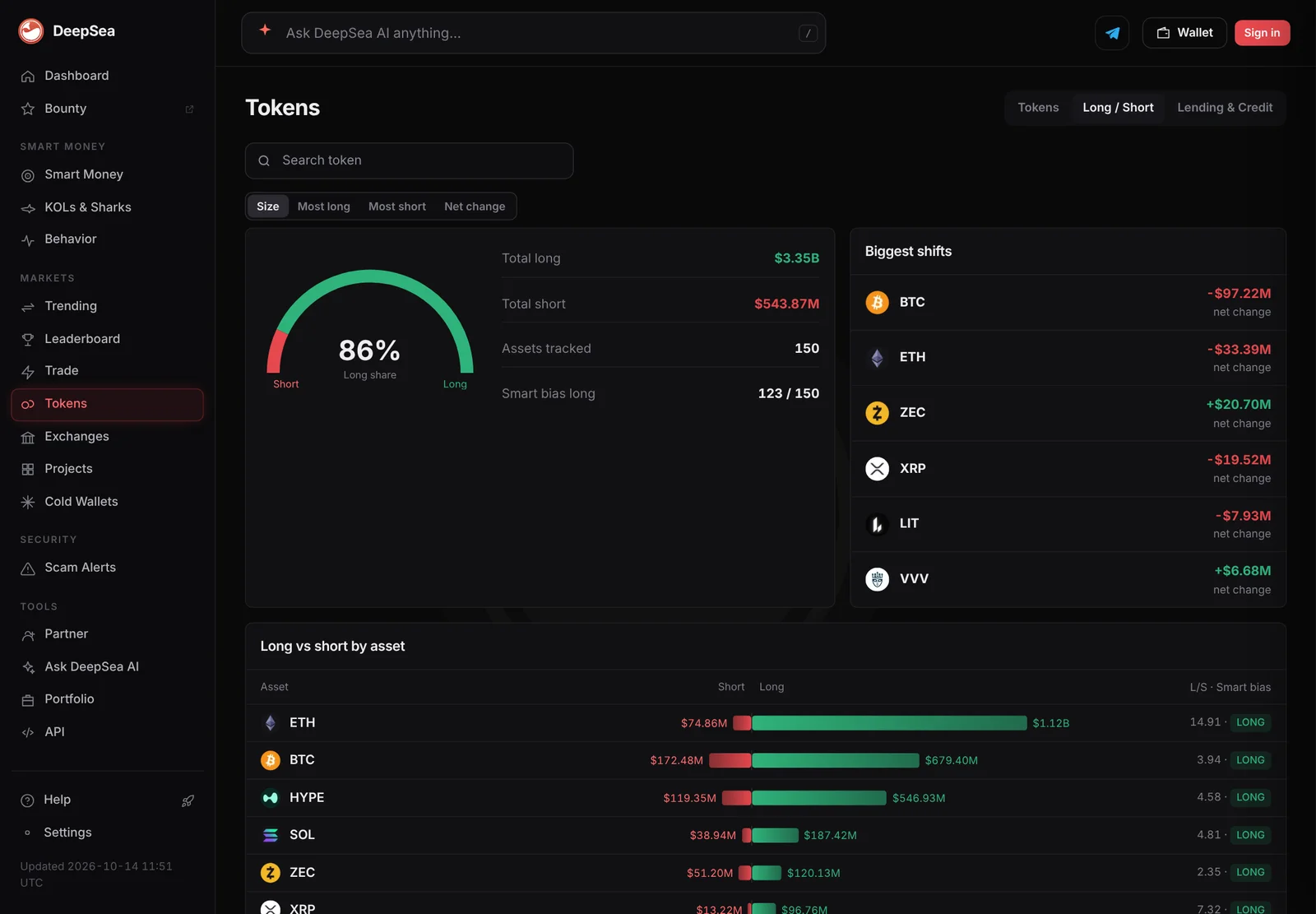
Data: DeepSea (desea.io), checked November 1, 2026, 11:09 p.m. ET.
Worst day in four months
Investors pulled $635.6 million out of US spot bitcoin ETFs (exchange-traded funds that hold real bitcoin) on Thursday, October 22, 2026. That was a sharp swing from a $524.8 million inflow the day before, according to Farside Investors' flow data. The last bigger one-day outflow in Farside's table was $691.7 million on June 25, 2026.
The selling undid a strong start to the week. The funds took in $526.7 million on Monday, $23.2 million on Tuesday and $524.8 million on Wednesday, a three-day streak of about $1.07 billion. Thursday wiped out roughly 60% of it. The week was still about $439 million positive after the outflow.
It also flipped the month. By Farside's numbers, October went from about $460 million of net inflows after Wednesday to about $176 million of net outflows after Thursday.
Who sold
The largest fund led the exit. BlackRock's iShares Bitcoin Trust (IBIT) lost $254.1 million. Fidelity's Wise Origin Bitcoin Fund (FBTC) lost $217.5 million, and the ARK 21Shares Bitcoin ETF (ARKB) lost $109.4 million. Grayscale's GBTC lost $29.5 million and Bitwise's BITB $27.4 million. Morgan Stanley's MSBT was the only fund with an inflow, of $2.3 million, Farside's table shows.
The selling was spread across the big issuers rather than one fund, a sign of a broad cut in bitcoin exposure rather than one large holder leaving.
The selling did not stop on Thursday. Another $137.9 million left on Friday, October 23, led by IBIT with $110.3 million, Farside data show. Over two days, the funds gave back about $774 million, more than two-thirds of the three-day inflow streak.

Daily flows, October 19 to 23
Daily net flows into US spot bitcoin ETFs in the week of the sell-off. Positive numbers are money in, negative numbers money out.
US spot bitcoin ETF net flows, October 19 to 23, 2026
US$ million
Source: Farside Investors
What set it off: chips, oil and inflation
Investors dumped risky assets across US stocks that day. The Nasdaq Composite closed at 26,008.86, down 2.6% from 26,702.86 the day before, according to Nasdaq's historical data. The PHLX Semiconductor Index, which tracks chipmakers, fell 6.7% to 10,731.98, Nasdaq data show.
Oil added to the pressure. The Brent spot price rose to $125.39 a barrel on October 22 from $117.37 the day before, a gain of almost 7%, according to the US Energy Information Administration. Higher energy prices feed into inflation, which had already reached 3.7% a year in September, according to the Bureau of Labor Statistics. That keeps pressure on the Federal Reserve, whose policy committee was due to meet on October 27 and 28, according to the Fed's calendar.
Bitcoin slipped too. CoinGecko's daily data show bitcoin at about $81,100 on October 23 (UTC), down from about $84,100 on October 21, according to CoinGecko on November 2, 2026.

How October ended
October had been a choppy month for the funds. By October 16, net outflows for the month had reached about $615 million, with the single worst day on October 7, when $484.9 million left, Farside data show. The three-day streak from October 19 to 21 then pushed the month back to about $460 million of net inflows, before October 22 flipped it negative again.
The rest of the month stayed volatile. Flows turned positive from October 26 to 29, then the funds lost $643.2 million on October 30, slightly more than on October 22. That left October with about $516 million of net outflows in Farside's table. Cumulative net inflows since the funds launched in January 2024 stood at about $57.0 billion at the end of the month.
Bitcoin also kept sliding. CoinGecko shows it at about $77,200 on October 30.
Timeline
Worst early-October day: $484.9 million leaves bitcoin ETFs
Bitcoin ETFs take in $526.7 million
Third straight inflow day, $524.8 million; streak reaches about $1.07 billion
Nasdaq falls 2.6%, chip index 6.7%; bitcoin ETFs lose $635.6 million
Fed policy meeting
Bitcoin ETFs lose $643.2 million; October ends about $516 million negative
LC Insight analysis
This section is our reading of the facts above, not a statement of fact.
- We think October 22 showed how tightly bitcoin ETF flows now follow tech stocks. When chipmakers drop 6.7% in a day, the same fund managers appear to trim bitcoin in the same session.
- A swing from $525 million in to $636 million out in 24 hours says much of this money is short-term. The likely result is bigger daily flow swings, which can push prices harder in both directions.
- Oil is a crypto story now. Expensive energy keeps inflation high, and that limits how far the Fed can cut rates, which is what bitcoin bulls are waiting for.
What's next
- Daily ETF flows in November after a negative October
- Brent oil prices and the next CPI release
- The Fed's December 8 to 9 meeting
- Whether chip stocks stabilize
Disclaimer. This article is based on public information and the sources listed below as of the update time shown. It is for information only and is not investment, legal or tax advice. Figures may change as companies and authorities publish new data.
Sources
- Farside Investors, Bitcoin ETF Flow, All Data (US$m)
- Nasdaq, Nasdaq Composite (COMP) historical data
- Nasdaq, PHLX Semiconductor Index (SOX) historical data
- US Energy Information Administration, Europe Brent Spot Price FOB (daily)
- US Bureau of Labor Statistics, CPI release (October 14, 2026)
- Federal Reserve, FOMC meeting calendar
- CoinGecko, Bitcoin historical data