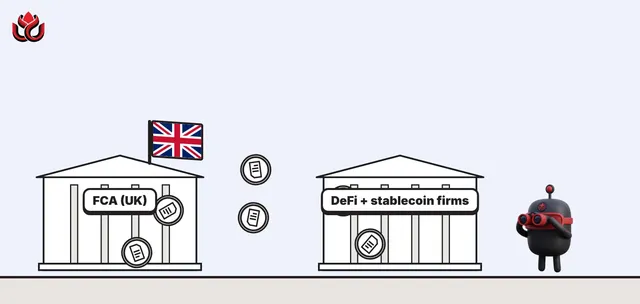
In or out? The FCA's crypto license map landed two weeks before UK firms could apply
Policy statement PS26/18 tells crypto firms which activities will need FCA authorization under the UK's new regime. Firms that miss the February 28, 2027, application deadline may have to stop trading, and one stablecoin question is still open.
Key points
- On September 16, 2026, the FCA published PS26/18, its final guide to which crypto activities need FCA authorization.
- The application gateway opened on September 30. Firms that apply by February 28, 2027, can keep operating while they are assessed; the regime starts on October 25, 2027.
- A pending government change on UK-issued stablecoins is not yet covered. The FCA plans to consult in late 2026 and publish updated guidance in early 2027.
What the FCA published
On September 16, 2026, the UK's Financial Conduct Authority (FCA) published PS26/18, a policy statement that tells crypto firms which of their activities will need an FCA license. According to the FCA's PS26/18 page, the guidance explains when firms will need permission for the new regulated cryptoasset activities, which start on October 25, 2027. It also covers exemptions and transitional run-off provisions.
It updates the FCA's Perimeter Guidance Manual (PERG), the part of the rulebook that helps a business work out whether it needs FCA permission. PS26/18 adds crypto to that map.
The policy statement responds to consultation paper CP26/13. That consultation ran from April 15 to June 3, 2026. The FCA said it received 78 responses and that most supported its approach.
Why firms need it now
The guidance arrived two weeks before the FCA's authorization gateway opened on September 30, 2026. Firms that apply by February 28, 2027, can keep carrying on specified activities while the FCA assesses their application, according to the FCA's regime overview. Firms that apply after the window closes may need to stop until they are authorized. The gateway page says the window must close at least 28 days before the new regime begins.
So this is a practical document. Before a firm can fill out an application, it needs to know which of its activities count as regulated and which permissions to ask for. Asking for too little can leave a business line unlicensed. Asking for too much adds cost and review time.
The core rules behind the regime came out on June 30, 2026, in five policy statements, PS26/9 to PS26/13, the FCA overview shows. They cover admissions, disclosures and market abuse; stablecoin issuance; regulated cryptoasset activities; a prudential regime for crypto firms; and how the wider FCA Handbook applies. PS26/18 tells firms which of those rules apply to them in the first place.

The gap: UK stablecoins
The regime rests on the Financial Services and Markets Act 2000 (Cryptoassets) Regulations 2026, which Parliament passed on February 4, 2026. The FCA says a government statutory instrument will amend those regulations, and its guidance depends on that change, according to the PS26/18 page.
The FCA's overview describes a draft statutory instrument published in April 2026. It would take activities involving UK-issued qualifying stablecoins out of the arranging and dealing activities and move them into a future payments regime. The FCA warns that this could change how parts of the regime apply, and tells firms to check the law in force at the relevant time.
To close the gap, the FCA plans to consult on further changes to the perimeter guidance in late 2026, and aims to publish the updated guidance in early 2027.
What firms should do
The FCA's message across its crypto pages is consistent. Existing registrations do not convert automatically. Any firm in scope of a regulated cryptoasset activity needs authorization, including firms already registered under the money laundering rules or authorized under the payments or e-money rules, the overview says. Firms can use the FCA's Pre-Application Support Service to prepare.
More rules are coming. The FCA plans consultations later in 2026 on how to handle a crypto firm's failure and on updates to its Financial Crime Guide. It will also consult on tailored guidance for decentralized finance (DeFi), without a date yet. It intends a formal review of the regime about two years after it comes into force.

Timeline
Parliament passes the Cryptoassets Regulations 2026
FCA consults on perimeter guidance in CP26/13
Government publishes draft statutory instrument on UK-issued stablecoins
FCA publishes core rules in PS26/9 to PS26/13
FCA publishes PS26/18 perimeter guidance
Authorization gateway opens
Planned FCA consultation on further perimeter guidance changes
Application window closes
Updated perimeter guidance expected
New regulated cryptoasset activities take effect
LC Insight analysis
This section is our reading of the facts above, not a statement of fact.
- We think PS26/18 is the document most UK applicants will read first, even if the core rules get the headlines. Whether you are in scope comes before every other compliance question.
- The stablecoin gap is a real risk for firms dealing in UK-issued stablecoins. Some will likely apply with one part of their business still unclear, and adjust once the early-2027 guidance lands.
- A two-stage map is not ideal, but it beats waiting for the law to settle. Firms at least have something to work from while the gateway is open.
What's next
- The FCA's late-2026 consultation on further perimeter guidance changes
- Parliament's handling of the statutory instrument on UK-issued stablecoins
- Updated perimeter guidance expected in early 2027
- The February 28, 2027, application deadline
Disclaimer. This article is based on public information and the sources listed below as of the update time shown. It is for information only and is not investment, legal or tax advice. Figures may change as companies and authorities publish new data.