GENIUS Act explained: what the US stablecoin law requires and who enforces it
The GENIUS Act is the US federal law for payment stablecoins. It requires full reserves, quick redemption and no interest for simply holding a token, and it takes effect on January 18, 2027, under the OCC's final rule.
Key points
- The GENIUS Act, enacted in July 2025, sets federal rules for payment stablecoins: tokens meant to hold a steady dollar value and be redeemable for dollars.
- Issuers must hold reserves worth at least the value of every token outstanding, in cash, deposits, short-term Treasuries and similar assets, and may not pay interest just for holding the coin.
- The OCC, Federal Reserve and FDIC oversee different kinds of issuers, states can supervise smaller ones, and Treasury writes the anti-money laundering rules.
- The OCC's final rule and the law take effect on January 18, 2027. As of November 2, 2026, OCC applications had not opened.
 What DeepSea's data shows
The freeze and block requirement already has a real-world test case. After the October Binance breach, DeepSea reports that stablecoin issuers froze more than 1.5 billion USDT, about 800 million USDC, 40.5 million RLUSD and 27.8 million USD1.
Freezes have limits. DeepSea says about 700 million USDT left two wallets before they were blacklisted, showing that the power to freeze works only as fast as issuers act.

Data: DeepSea (desea.io), checked November 2, 2026, 7:59 a.m. ET.
What is the GENIUS Act?
The GENIUS Act is the US law that created a federal framework for payment stablecoins. It was enacted in July 2025, according to a Federal Reserve staff memo, and Treasury's anti-money laundering proposal of April 8, 2026 calls it the federal stablecoin law. The bill was S. 1582 in the Senate, and its text is on congress.gov.
A payment stablecoin is a crypto token designed to keep a steady value against the US dollar and to be redeemable for dollars. The law calls approved companies permitted payment stablecoin issuers, often shortened to PPSIs.
The law does not run itself. Bank regulators and the Treasury must write rules to put it into practice, and most of 2026 has been spent on that work.
What does the GENIUS Act require of issuers?
The core rules are about backing, redemption and yield. The Federal Reserve's September 2026 proposal sums them up for the issuers it supervises:
- Full reserves: at all times, reserve assets must have a fair value that equals or exceeds the par value of all tokens outstanding.
- Safe reserve assets: US dollar cash, balances at Federal Reserve Banks, deposits at insured banks, Treasury bills and bonds with 93 days or less to maturity, overnight repo deals backed by Treasuries, funds that hold only these assets, and certain tokenized versions of them.
- Fast redemption: the Fed proposal would require a public redemption policy with a redemption period of no more than two business days, unless a safe harbor applies.
- No interest for holding: the law bans paying interest or yield solely for holding, using or keeping a payment stablecoin.
Issuers also become financial institutions under the Bank Secrecy Act, the main US anti-money laundering law. A Treasury proposal from April 2026 would require a written anti-money laundering program, suspicious activity reports and a sanctions compliance program. Issuers would also need the technical ability to block, freeze and reject certain transactions, including in secondary market trading, according to FinCEN.

Who regulates stablecoin issuers?
The GENIUS Act spreads oversight across several agencies, based on what kind of company issues the coin:
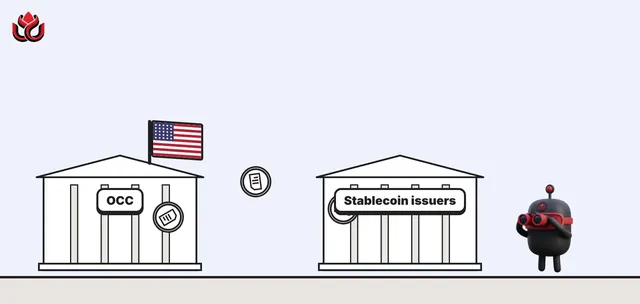
- OCC: the Office of the Comptroller of the Currency, which charters national banks, oversees permitted and foreign payment stablecoin issuers under its jurisdiction, plus certain custody activities, the OCC says.
- Federal Reserve: supervises approved subsidiaries of insured state member banks, and large state-chartered issuers that move into its framework, per its proposal.
- FDIC: proposed a framework for FDIC-supervised issuers and banks that hold stablecoin reserves or provide custody, the FDIC said.
- States: can supervise state qualified issuers. Under the Fed proposal, an uninsured state-chartered issuer with $10 billion or more in tokens outstanding can move to the federal framework or seek a waiver to stay with its state regulator only.
- Treasury: FinCEN and the Office of Foreign Assets Control write the anti-money laundering and sanctions rules.
What anti-money laundering rules apply to stablecoin issuers?
Treasury's proposal, written by FinCEN and the Office of Foreign Assets Control, spells out what an issuer's compliance program would need, according to FinCEN's fact sheet:
- a written anti-money laundering program approved by the board or senior management, with risk assessments, ongoing customer due diligence, independent testing, staff training and a compliance officer located in the US;
- suspicious activity reports for suspicious transactions linked to possible violations of law, with no such reporting duty proposed for secondary market trades;
- records for transfers of $3,000 or more, and passing transfer details on to other financial institutions, a version of the so-called travel rule;
- answering FinCEN information requests, with optional information sharing among institutions;
- a sanctions program with five parts: senior management commitment, risk assessments, internal controls, testing and auditing, and training.
The comment period closed on June 9, 2026. A final rule had not been published on the pages we checked as of November 2, 2026.

When does the GENIUS Act take effect?
The law takes effect on the earlier of January 18, 2027, or 120 days after the main regulators issue final rules, the Fed memo explains. The OCC issued its final rule on October 21, 2026, and both the rule and the law take effect on January 18, 2027, the OCC said.
There is a catch. As of November 2, 2026, the OCC had not started accepting applications. It says it will announce that in a separate release. LC Insight explained the tight deadline when the rule came out.
Timeline
GENIUS Act enacted
FDIC proposes its framework (April 7); Treasury proposes anti-money laundering and sanctions rules (April 8)
Federal Reserve staff send the Board a proposal for issuers it supervises
OCC issues its final rule
OCC rule and GENIUS Act take effect
What does it mean for people who hold stablecoins?
For holders, the main promise is that each token is backed by safe, liquid assets worth at least its face value, and that it can be cashed in quickly. The flip side is the yield ban: an issuer cannot pay you interest just for holding its coin. The Fed proposal would also presume some third-party arrangements to be prohibited, so the line between a reward and a disguised interest payment will matter.
Bank tokens are treated differently. The FDIC's proposal says tokenized deposits that meet the legal definition of a deposit are treated no differently from other deposits under federal deposit insurance law, the agency said. A tokenized deposit is a bank deposit recorded on a blockchain. That is not the same thing as a payment stablecoin.
What is still unfinished?
Several pieces were still proposals as of November 2, 2026. Treasury's anti-money laundering rule, the FDIC framework and the Federal Reserve framework had not been finalized on the pages we checked. The OCC's own rule leaves Bank Secrecy Act, anti-money laundering and sanctions requirements to a separate rulemaking with Treasury, it says.
That leaves less than three months for issuers to apply, for regulators to process applications and for compliance programs to be in place before the effective date.
LC Insight analysis
This section is our reading of the facts above, not a statement of fact.
- We think the real risk is timing, not design. The rules on reserves and redemption are clear, but with applications not open as of November 2, 2026, issuers have little time to get approved before the effective date.
- The yield ban is where the next fight sits. Exchanges and apps that share rewards with stablecoin holders will watch how regulators apply the presumption against third-party arrangements.
- The freeze and block requirement in Treasury's proposal makes compliant stablecoins more controllable than most crypto. That is a feature for regulators and a trade-off users should understand.
What's next
- The OCC's announcement that applications and waiver requests are open
- Final Treasury anti-money laundering and sanctions rules for issuers
- Final FDIC and Federal Reserve frameworks
- January 18, 2027, effective date
Frequently asked questions
Can a stablecoin issuer pay interest under the GENIUS Act?
No. The law bans paying interest or yield solely for holding, using or keeping a payment stablecoin, and the Fed's proposal would presume some third-party arrangements to be prohibited.
What assets can back a GENIUS Act stablecoin?
Cash, Federal Reserve balances, insured bank deposits, Treasuries with 93 days or less to maturity, overnight Treasury-backed repos, funds holding only those assets and certain tokenized versions, according to the Federal Reserve's proposal.
Does the GENIUS Act cover foreign stablecoin issuers?
Yes. The OCC's final rule covers foreign payment stablecoin issuers under its jurisdiction as well as US issuers.
How fast must issuers redeem tokens?
The Federal Reserve's proposal would require a redemption period of no more than two business days for the issuers it supervises, unless a safe harbor applies.
Disclaimer. This article is based on public information and the sources listed below as of the update time shown. It is for information only and is not investment, legal or tax advice. Figures may change as companies and authorities publish new data.
Sources
- Federal Reserve, staff memo on GENIUS Act proposal (September 2026)
- OCC, News Release 2026-92 on GENIUS Act final rule (October 21, 2026)
- US Treasury, proposed rule on GENIUS Act illicit finance requirements (April 8, 2026)
- FinCEN, fact sheet on the stablecoin issuer AML/CFT proposal (April 2026)
- FDIC, proposal to implement GENIUS Act requirements (April 2026)
- Congress.gov, S. 1582 GENIUS Act text