Stablecoin issuers need OCC approval by January 18, 2027. Applications are not open yet
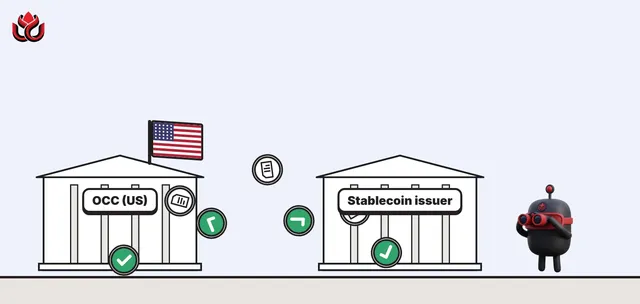
The US bank regulator finalized its GENIUS Act rule on October 21, 2026. Issuing a US payment stablecoin without approval becomes a crime in January, and existing issuers will lean on waivers.
Key points
- The OCC finalized its GENIUS Act rule for stablecoin issuers on October 21, 2026, and it takes effect on January 18, 2027.
- From that date, issuing a payment stablecoin in the US generally requires approval, and doing it without approval carries criminal penalties. Applications have not opened.
- Existing issuers with a near-complete application can expect a waiver for up to 12 months. New issuers cannot.
The rule
The Office of the Comptroller of the Currency (OCC), which charters and supervises national banks, issued its final rule implementing the GENIUS Act on October 21, 2026. From January 18, 2027, issuing a payment stablecoin in the US will generally require approval, yet the OCC has not started taking applications. The GENIUS Act, signed into law on July 18, 2025, created a federal framework for payment stablecoins. These are tokens meant to keep a steady value against the dollar and to be redeemable for it.
The rule sets requirements for permitted payment stablecoin issuers and foreign payment stablecoin issuers under OCC oversight, and covers some custody activities by banks the OCC supervises, the OCC said. Rules on anti-money laundering, the Bank Secrecy Act and sanctions compliance are left to a separate rulemaking with the US Treasury.
Comptroller Jonathan Gould said, "We are providing a clear, practical framework for payment stablecoin innovation." The OCC's release also quoted Treasury Secretary Scott Bessent, who compared the law to the National Currency Act of 1863.
What the rule covers
The rule adds a new part 15 to the OCC's regulations, Bulletin 2026-50 says. That part covers permitted activities, reserve assets, redemption, risk management, audits and supervision, custody, applications and registrations, the examination of foreign issuers, revocation of approval, the move of state issuers into the federal system, and a capital and operational backstop. The rule also amends the OCC's existing rules on bank capital, prompt corrective action, fees and procedure.
It applies to a broad group:
- national banks and federal savings associations, and their subsidiaries;
- federal branches of foreign banks and their subsidiaries;
- foreign payment stablecoin issuers;
- nonbank companies seeking or holding federal approval as qualified payment stablecoin issuers;
- state qualified issuers over which the OCC has regulatory or enforcement authority.
The rule keeps the GENIUS Act's ban on paying interest or yield to holders simply for holding, using or keeping a payment stablecoin. It also refers to the $10 billion threshold at which state issuers move to the federal framework, and says the OCC may look at affiliates if they are used to stay under that line, according to the final rule text.

About 328 comments and what changed
The OCC proposed the rule on February 25, 2026, and it was published in the Federal Register on March 2. The comment period closed on May 1, and the OCC accepted late comments until July 1. It received about 328 comments, according to the final rule.
The OCC says the final version gives issuers more flexibility in managing reserve assets, while keeping the core requirements on liquidity, diversification and concentration. It describes the capital requirements as more detailed than the proposal but consistent with it. Some commenters had opposed any freeze or extension of redemptions during spikes in requests, the rule text notes.
OCC GENIUS Act timeline, in days
days
LC Insight calculation from dates in OCC Bulletin 2026-50 and Bulletin 2026-51
Why the deadline is tight
Timing is the hard part. From January 18, 2027, a person generally must be approved as a permitted payment stablecoin issuer to issue a payment stablecoin in the United States, and issuing without approval carries criminal penalties, Bulletin 2026-51 says.
Yet applications are not open. The OCC says it will start accepting applications and waiver requests after the Office of Management and Budget gives final approval to the forms, and it will announce the start date in a press release.
Once an application arrives, the OCC says it will tell the applicant within 30 days whether it is substantially complete. If not, it will list what is missing. It commits to act on an application no later than 120 days after finding it substantially complete.

Waivers for existing issuers
The law lets the OCC waive requirements for up to 12 months from January 18, 2027. Under the final rule, an issuer with a substantially complete application pending can ask for a waiver in writing. The OCC says it generally expects to grant waivers from the prior approval requirement to existing issuers, unless its review finds a more compelling reason to deny, the bulletin says.
There are limits. Waivers cover only the approval requirement and other provisions an applicant cannot meet by the effective date, and they last only as long as needed. The OCC does not expect to grant waivers to new issuers that are not already operating in the US. It says those companies should start only after approval. It plans to act on waiver requests generally by January 18, 2027.
Timeline
GENIUS Act enacted
OCC proposes its GENIUS Act rule
Proposal published in the Federal Register
Comment period closes; late comments accepted to July 1
OCC issues the final rule and Bulletins 2026-50, 2026-51 and 2026-52
Final rule and GENIUS Act take effect
LC Insight analysis
This section is our reading of the facts above, not a statement of fact.
- The waiver policy is the detail that matters most now. Existing issuers that file in time can keep operating, while newcomers must wait, which tilts the field toward companies already in the market.
- The window is tight. With forms still waiting for approval and a January deadline, we expect a rush of filings around New Year's and a heavy load on OCC staff.
- Anti-money laundering and sanctions rules are still to come in a separate rulemaking, so issuers do not have the full rulebook. That is a real risk for anyone planning an early-2027 launch.
What's next
- The OCC announcement opening applications and waiver requests
- The separate anti-money laundering and sanctions rule from Treasury and the OCC
- How the $10 billion state-to-federal threshold is applied in practice
Disclaimer. This article is based on public information and the sources listed below as of the update time shown. It is for information only and is not investment, legal or tax advice. Figures may change as companies and authorities publish new data.