
Crypto exchange license by country: UAE, Singapore, EU, UK, Hong Kong, US
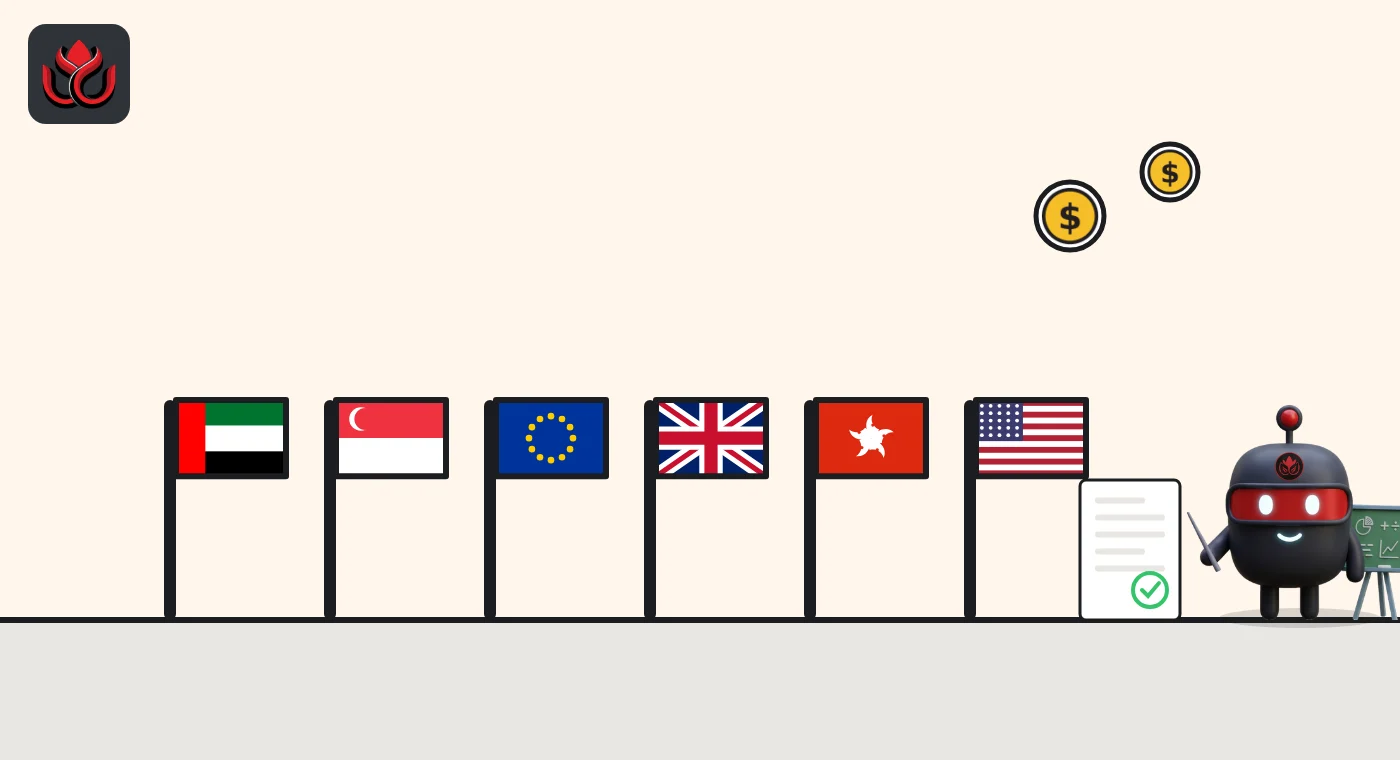
Every major market has its own crypto exchange license: VARA in Dubai, MAS in Singapore, MiCA in the EU, FCA registration in the UK, the SFC regime in Hong Kong and FinCEN plus state licenses in the US. Each regulator publishes a register you can check.
Key points
- There is no global crypto license: a firm needs approval in each market where it serves clients, except inside the EU, where a MiCA license can be passported.
- Capital floors differ: EUR 50,000 to EUR 150,000 under MiCA, AED 100,000 to AED 1,500,000 per activity in Dubai, S$100,000 or S$250,000 in Singapore, and case by case in New York.
- In the US, FinCEN registration is federal, but states such as New York require their own license; New York says its bond or funded account is generally at least $500,000.
- The UK moves from anti-money laundering registration to full FCA authorization, with new rules applying to firms permitted from October 25, 2027.
- Every regulator in this guide runs a public register, the simplest way to check a platform.
Why does a crypto exchange need a license in each country?
Crypto trading is global, but licensing is local. A regulator's approval usually covers clients in its own market only. An exchange that serves users in Dubai, Singapore and Paris needs approval from each authority, or it must block those users.
The one big exception is the European Union. Under MiCA, a license from one EU country can be passported to the others. This guide compares six markets by regulator, license name, legal basis, any capital figure the regulator states, and where the public register sits. It is general information, not legal advice.
Two words matter here. A license or authorization means the regulator has assessed the firm and allowed it to offer a service. A registration, as with FinCEN in the US or the FCA's current crypto regime in the UK, is mainly an anti-money laundering status. The two are often confused in exchange marketing, so the register entry is worth reading closely. Capital figures differ too: some regimes print a number in the law, others set it case by case for each firm.
How do crypto exchange licenses compare by country?
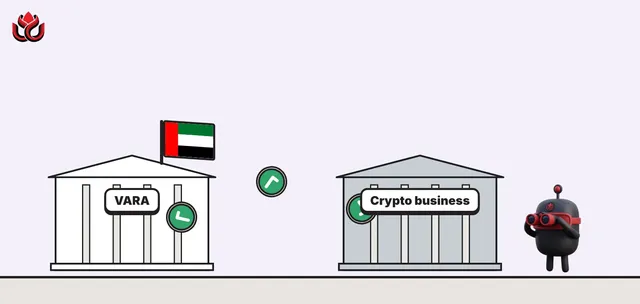
United Arab Emirates (Dubai)
- Regulator: the Virtual Assets Regulatory Authority (VARA).
- License: a VARA license for virtual asset service providers (VASPs), issued per activity.
- Legal basis: the Virtual Assets and Related Activities Regulations 2023 and VARA's rulebooks.
- Minimum paid-up capital: set per activity in VARA's Company Rulebook, from AED 100,000 for advisory to AED 1,500,000 for exchange services without a VARA-licensed custodian, or a share of fixed annual overheads if higher.
- Scope: Dubai's mainland and free zones, except the DIFC, Dubai's international financial center, VARA says.
- Register: VARA public register of licensed VASPs.
- Abu Dhabi: the Abu Dhabi Global Market (ADGM) is a separate financial center with its own regulator, the FSRA.
Singapore
- Regulator: the Monetary Authority of Singapore (MAS).
- License: a payment services license that covers digital payment token (DPT) services.
- Legal basis: the Payment Services Act 2019, in force since January 28, 2020, and amended on April 4, 2024.
- Extra checks: since August 26, 2024, all new and variation applications for DPT services need an independent external auditor assessment of anti-money laundering and consumer protection controls.
- Base capital: at least S$100,000 for a standard payment institution and S$250,000 for a major payment institution, per MAS.
- Register: the MAS Financial Institutions Directory.
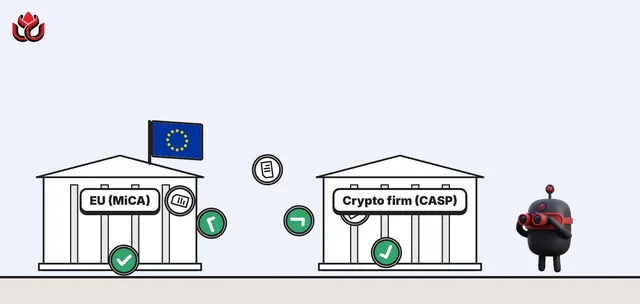
European Union
- Regulator: national competent authorities in each EU country, with ESMA coordinating.
- License: CASP authorization under MiCA.
- Legal basis: Regulation (EU) 2023/1114.
- Minimum capital: EUR 50,000, EUR 125,000 or EUR 150,000 under Annex IV (EUR 150,000 for a trading platform), or a quarter of last year's fixed overheads if higher.
- Register: ESMA's interim MiCA register, updated weekly.
United Kingdom
- Regulator: the Financial Conduct Authority (FCA).
- License today: registration with the FCA under the Money Laundering Regulations (MLRs); the FCA has been anti-money laundering supervisor for cryptoasset firms since January 10, 2020.
- Next: a full authorization regime under FSMA; the FCA published final rules on June 30, 2026, which cover firms that receive permission from October 25, 2027, onward, it says.
- Register: the FCA Financial Services Register.
Hong Kong
- Regulator: the Securities and Futures Commission (SFC).
- License: a license as a virtual asset trading platform (VATP) operator.
- Legal basis: the SFC regime under the Securities and Futures Ordinance and the regime under the Anti-Money Laundering and Counter-Terrorist Financing Ordinance, plus the Guidelines for VATP Operators.
- Register: the SFC's lists of virtual asset trading platforms.
United States
- Federal: registration as a money services business (MSB) with FinCEN, the Treasury's financial crimes unit; check it in the MSB Registrant Search.
- State: separate state licenses. In New York, the BitLicense under 23 NYCRR Part 200, issued in June 2015.
- New York capital: set case by case under 23 NYCRR 200.8, plus a surety bond or trust account under 200.9 that is generally at least $500,000, per NYDFS.
- Register: the regulated entities list on the NYDFS site.
How does Dubai's VARA license work?
VARA oversees how virtual assets are offered, used and traded in or from Dubai, its site says. It describes itself as the regulator across the emirate's mainland and free zones, with one carve-out: the DIFC, which has its own financial regulator. Abu Dhabi's ADGM is also separate, so a firm licensed in one UAE financial zone is not automatically licensed in the other.
Our Dubai VARA license guide covers its licensed activities, steps, capital and fees in more detail.
What does Singapore require from crypto exchanges?
In Singapore, crypto trading and exchange services fall under the Payment Services Act as digital payment token services. MAS added tougher entry checks in 2024: since August 26, 2024, it asks for an independent external auditor assessment on all new license and variation applications for DPT services, and a legal opinion for some new applications, its payments page says.
Singapore also has rules for firms based there that serve only overseas customers. Our Singapore MAS DPT license guide covers who needs a MAS license, including the rules for those firms.
How is the UK crypto regime changing?
Today, UK crypto firms register with the FCA for anti-money laundering purposes. Registration is a lighter status than full authorization. Still, a registered firm can rely on a specific exemption to promote crypto to UK consumers, the FCA says.
The bigger shift is the new regime under the Financial Services and Markets Act (FSMA). The FCA published its final rules on June 30, 2026, and they will cover firms that receive FSMA permission from October 25, 2027, onward.
What do Hong Kong and the US require?
Hong Kong runs a dedicated licensing regime for trading platforms. The SFC says licensed platforms face a wide range of regulatory requirements and publishes lists of licensed platforms. Our Hong Kong crypto licensing guide explains the regime in depth.
The US has two layers. A crypto exchange registers with FinCEN as a money services business, which is a federal anti-money laundering registration. States then license on top. In New York, no one may engage in virtual currency business activity involving New York or a New York resident without a license from the superintendent, under 23 NYCRR 200.3. That covers transmitting, holding custody of, buying and selling, and exchanging virtual currency for customers, and issuing one. A New York limited purpose trust charter is an alternative route.
How can you check if a crypto exchange is licensed?
Use the regulator's own register, not the exchange's website. Search for the exact legal name of the entity that serves your country, because big exchanges often run several companies, each licensed in a different place.
Check three things: that the license is current, that it covers the service you use (custody, trading or exchange), and that it covers your country. ESMA's EU register, for example, keeps withdrawn licenses in the file with the withdrawal date. The MiCA rules are covered in our MiCA CASP license guide.
LC Insight analysis
This section is our reading of the facts above, not a statement of fact.
- We think the most common reader mistake is checking the brand, not the legal entity. A big exchange can be licensed in one market and unlicensed in another under the same logo.
- The UK's 2027 switch to full authorization is the next big licensing event in this list. Firms registered only for anti-money laundering today will need a new permission.
- MiCA's passport gives the EU a scale advantage the other regimes do not offer, which is why so many global platforms have sought an EU license.
What's next
- UK firms applying for FSMA permission ahead of October 25, 2027
- Weekly changes to ESMA's register of authorized CASPs
- Coordination between UAE regulators on a single register
Frequently asked questions
Which country has the easiest crypto exchange license?
LC Insight does not rank regimes. Each regulator sets its own requirements, and a license only covers its own market, except MiCA's EU passport.
Is FinCEN MSB registration a license?
It is a federal registration with FinCEN. Exchanges serving US customers also deal with state licensing, such as New York's BitLicense.
Does a Dubai VARA license cover all of the UAE?
No. VARA covers Dubai's mainland and free zones except the DIFC, and Abu Dhabi's ADGM has its own regulator, the FSRA.
Does UK FCA registration mean a crypto firm is authorized?
Not yet in the full sense. Today it is registration under the Money Laundering Regulations, and the new FSMA regime applies to firms granted permission from October 25, 2027.
How much capital does a crypto exchange need in the EU?
At least EUR 150,000 for a firm that operates a trading platform under MiCA Annex IV, or a quarter of last year's fixed overheads if higher.
Disclaimer. This article is based on public information and the sources listed below as of the update time shown. It is for information only and is not investment, legal or tax advice. Figures may change as companies and authorities publish new data.